

Spiral wound membranes
Construction, size codes, sanitary or industrial design, feed spacers and operating limits.
How a spiral wound element is built
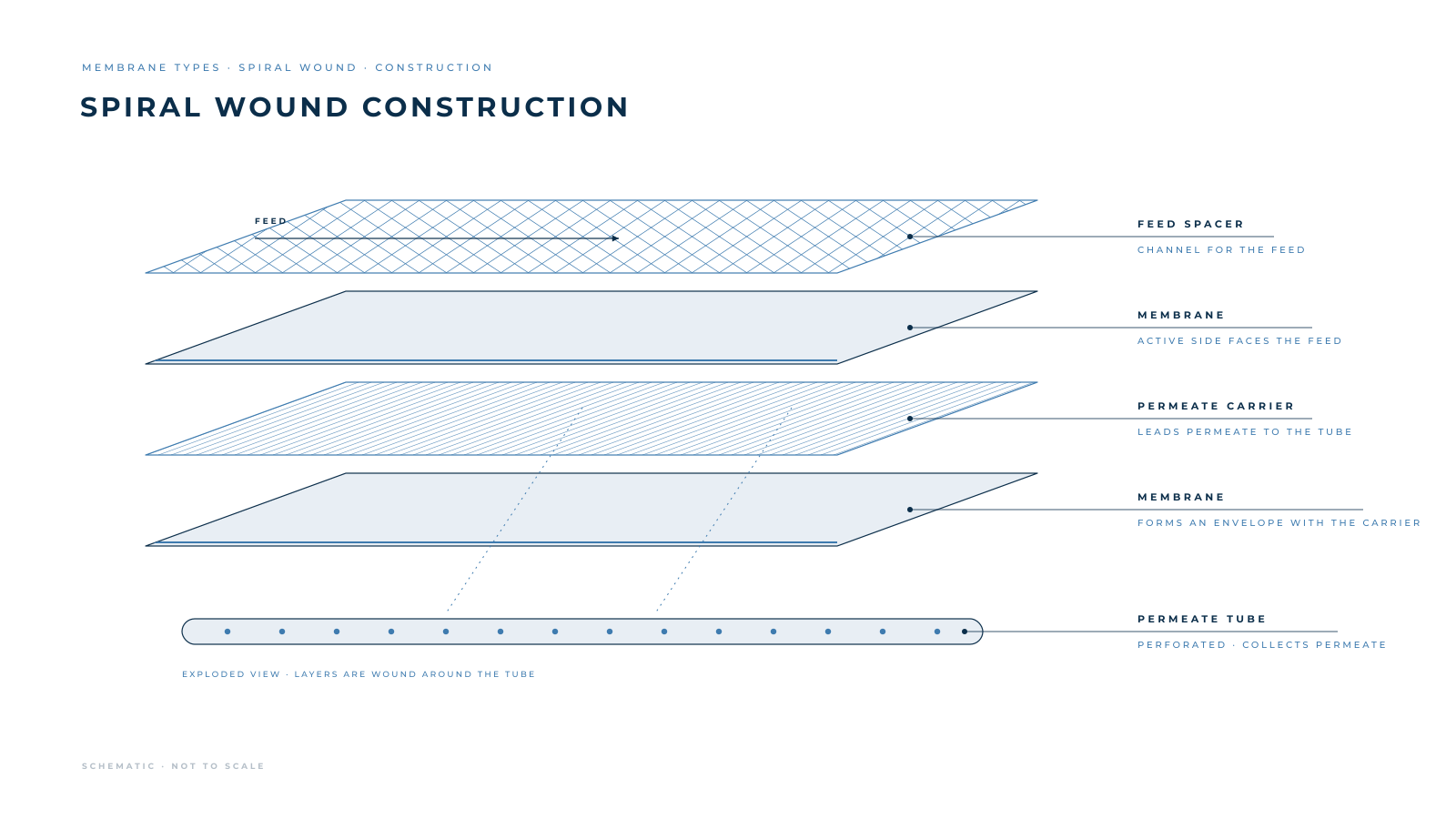
Flat-sheet membrane is folded into envelopes, or leaves, around a permeate carrier and sealed with glue lines on three sides. The leaves are wound around a perforated permeate tube, with a feed spacer between them. Feed flows lengthwise through the spacer channels; what passes the membrane spirals inward to the tube. The same construction serves every process from microfiltration (MF) to reverse osmosis (RO); the membrane on the leaves sets the separation.
Size codes
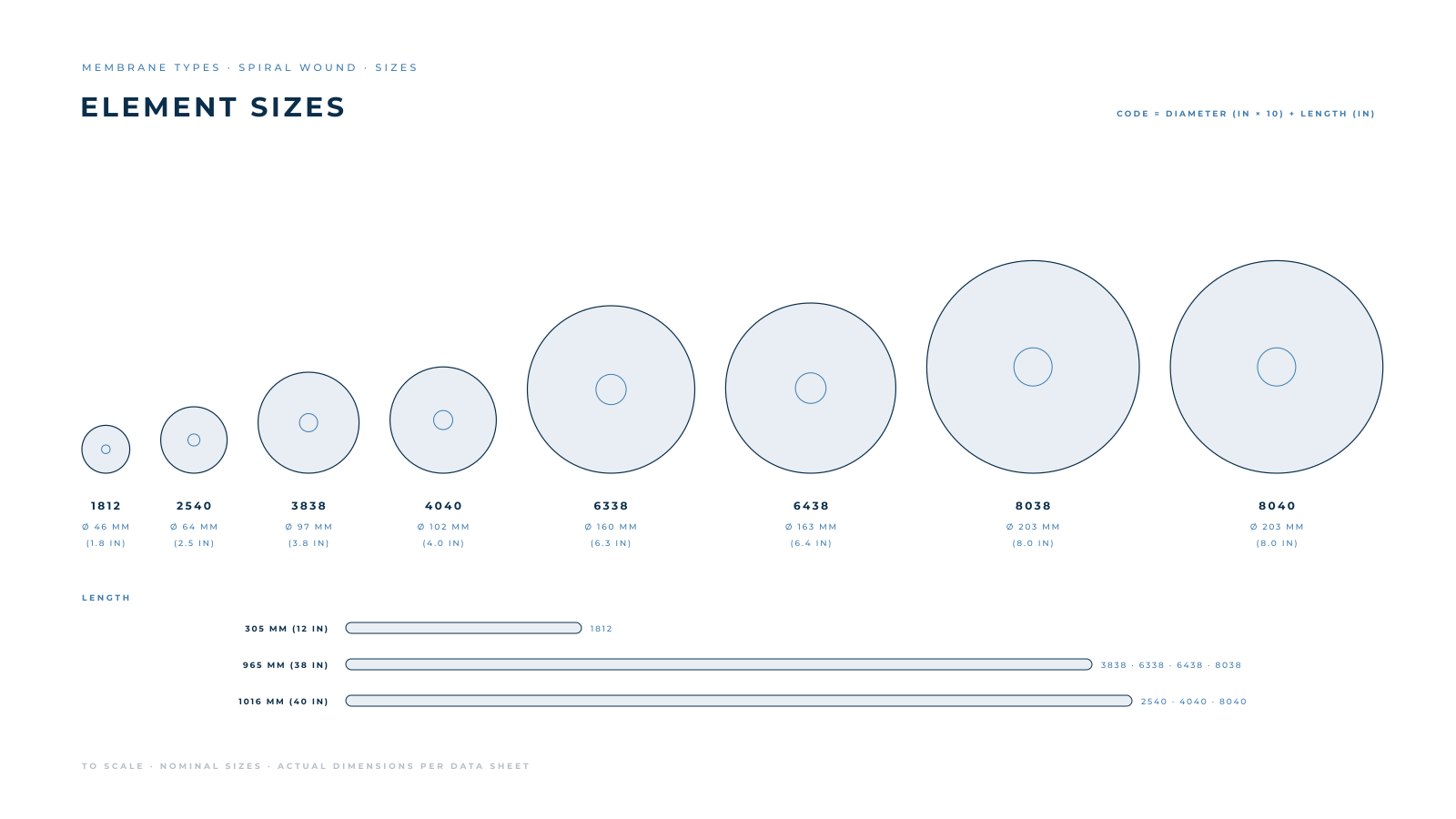
The code gives diameter and length in inches: 8040 is 8.0 by 40 inch. Dimensions below are taken from manufacturer data sheets.
| Code | Diameter | Length | Usual design |
|---|---|---|---|
| 3838 | 96 mm (3.78") | 965 mm (38.0") | Sanitary |
| 3840 | 96 mm (3.78") | 984 mm (38.75") | Sanitary |
| 6338 | 162 mm (6.36") | 965 mm (38.0") | Sanitary |
| 8038 | 201 mm (7.9") | 965 mm (38.0") | Sanitary |
| 8040 | 200 to 201 mm (7.9") | 1016 mm (40.0") | Industrial; sanitary with ATDs as a specialty |
Sanitary or industrial
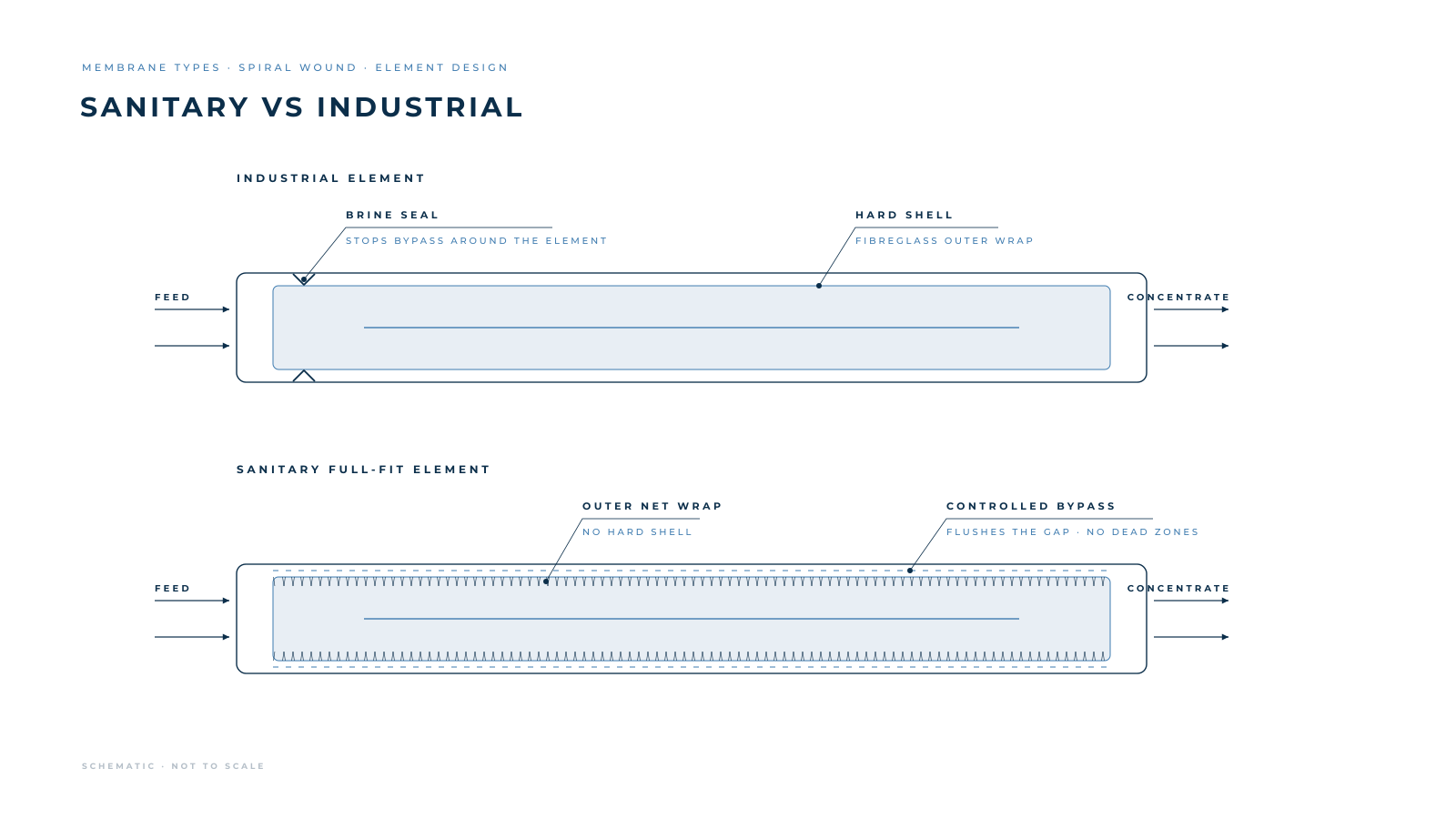
The membrane can be the same; the construction around it differs.
| Sanitary | Industrial | |
|---|---|---|
| Outer shell | Cage (net) or solid ribbed shell | Fibreglass outer wrap |
| Anti-telescoping device (ATD) | None; versions with ATDs exist as a specialty | Fixed ATDs |
| Usual lengths | 965 mm (38") | 1016 mm (40") |
| Food contact | Compliance stated on the data sheet, for example EC 1935/2004, EU 10/2011 and US FDA 21 CFR | Not stated |
| Used in | Food, dairy, beverage, pharma | Process water, concentration, reuse |
Same membrane, two constructions
One nanofiltration (NF) membrane in both designs, from one manufacturer's data sheets. The construction alone changes the limits.
| Limit | Sanitary | Industrial |
|---|---|---|
| Outer wrap | Net wrap | Fibreglass (FRP) |
| Maximum operating pressure | 55 bar (800 psi) | 40 bar (580 psi) |
| Maximum operating temperature | 50 °C | 45 °C |
| pH, cleaning | 1.8 to 11 | 2 to 12 |
| Membrane area, 8040 | 36 m² (31 mil spacer) | 37 m² |
Feed spacer
Spacer thickness is given in mil: 1 mil is 0.0254 mm. A thicker spacer handles viscous or particle-laden feed better but leaves room for less membrane. A sanitary 8040 NF element, for example, is offered with 28, 31 or 46 mil spacers: 36 m² of membrane with 28 or 31 mil, 25 m² with 46 mil (1.17 mm), 31% less area. A sanitary 8038 RO element has 36 m² with a 30 mil (0.76 mm) spacer and 28 m² with 46 mil, 22% less.
Operating limits: two RO examples
Limits differ per element type; the data sheet of the actual element governs. Two RO elements from the same maker show how far they can differ.
| Limit | Sanitary RO, 8038 | Industrial RO, 8040 |
|---|---|---|
| Maximum applied pressure | 55 bar (800 psig) | 41.4 bar (600 psig) |
| Maximum operating temperature | 50 °C | 45 °C |
| pH, continuous operation | 2 to 11 | 2 to 10.8 |
| pH, cleaning | 1.5 to 11.5 at ambient; 1.8 to 11.0 at 50 °C | 1 to 12.5 |
| Free chlorine | < 0.1 ppm | < 0.1 ppm |
Heat-sanitisable sanitary elements go further: one high-temperature version allows sanitisation at 85 °C or continuous operation at 70 °C.
Questions
What does a size code such as 8040 mean?
The first two digits give the diameter in tenths of an inch, the last two the length in inches: 8040 is 8.0 inch by 40 inch. Real diameters are slightly smaller than nominal, for example 200 mm (7.89 inch) for an industrial 8040 RO element.
What is the difference between 8038 and 8040?
Length: 965 mm (38 inch) against 1016 mm (40 inch), at the same diameter of about 201 mm. 8038 is the usual sanitary size for food and dairy; 8040 is the usual industrial size. They fit different pressure vessels, so check the vessel before changing size.
What is an ATD?
An anti-telescoping device: a rigid end cap that stops the membrane leaves from shifting lengthwise under the force of the feed flow. Industrial elements have fixed ATDs; sanitary elements have none, except specialty versions.
Which feed spacer do I need?
A thicker spacer gives a wider feed channel, which handles viscous or particle-laden feed better, but leaves room for less membrane area per element. Clear feeds run on thin spacers; concentrates of milk, whey or juice often need thicker ones. We check this against your product.
What do you need for a quote?
Current brand and type, element size, quantity, and the application: product, temperature, pH and cleaning (CIP) regime.
High pressure or low flux?
Tell us what you run into. We like to think along with you, no strings attached.